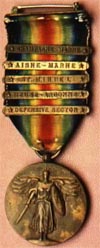
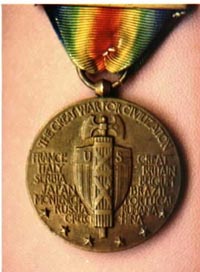
Page: 2 of 2
Previous Pages 1
- 2
In the early morning darkness of March 9, 1916,
guerillas of the Mexican Revolution led by Pancho Villa crossed into
the United States and attacked the small border town of Columbus, New
Mexico. The attack was prompted by the fact that a local merchant had
refused to deliver arms to Villa's gang, which they had bought and paid
for. As the sun rose that morning, Columbus was a smoking ruin. News of
the attack flashed across the country by telegraph, making headlines
from coast to coast.
As a result, a Punitive Expedition was organized,
led by General John "Black Jack" Pershing, who would later command the
Allied Forces in World War I. For 11 months, 10,000 troops ranged the
deserts and mountains of the state of Chihuahua, but to no avail.
Pancho Villa could not be found. The Punitive Expedition was the last
true cavalry action mounted by the Army, and the first military
operation to use mechanized vehicles. The troops, toughened by the
rigorous march through Mexico, would later board trains that would take
them to the looming conflict in Europe.
WHO WAS PANCHO VILLA?
Pancho Villa was born Doroteo Arango, a
share-cropper peasant on a hacienda in Durango, Mexico in 1878. Legend
has it that one day he returned home from the fields to find that his
sister had been raped by the hacienda owner. Enraged, he shot and
killed the owner, then escaped into the mountains on horseback. He
joined a band of cattle rustlers headed by a man named Pancho Villa.
When their leader was killed in a skirmish with mounted police, Doroteo
assumed leadership of the gang and took the fallen leader's name,
Pancho Villa. He was a very successful bandit, leading raids on towns,
killing and looting, until the Mexican Revolution broke out in 1910,
and he was recruited to lead the struggle in Northern Mexico. His
charisma and victories made him an idol of the masses. After the war
ended, many attempts were made on his life by relatives of those he had
killed. Finally, in 1923, Pancho Villa was assassinated in the town of
Parral, Mexico.
WORLD WAR I AND THE AMERICAN EXPEDITIONARY FORCE
The United States declared war on Germany in
1917, but it had only fought in support of British and French units.
That is, until September of 1918, when the American Expeditionary Force
(AEF), led by General Pershing, launched its first major offensive.
Their successful campaign was a major turning point of the war for the
Allies. Ultimately, U.S. forces would bring about an earlier than
expected end to the war.
CHATEAU - THIERRY AND THE BATTLE FOR BELLEAU WOOD
This was the first battle where the AEF
experienced the heavy casualties associated with the Great War. The
three week long action was simply a confused mess tactically. None of
the participants ever quite knew where they, the front line or the
enemy were inside that mile-square dark forest. - from the Doughboy
Center
These men had never been in a forward movement
and they had come up there looking upon an attack as something of a
lark. This helped the situation materially, even though the events of
the morning had dampened their enthusiasm considerably. Also, while not
exactly understanding the situation, there was a settled feeling among
the men that somehow things had been messed up and that they were the
goats.
…(As they advanced, one) lieutenant was badly
wounded crossing the wheat field. As for barbed wire, the men stamped
it down with the butts of their rifles and shoes, hurdled it, crawled
under it - got through it somehow.
The advance began at 8:20 in the indicated
formation. As soon as it started, hell broke loose. The enemy knew that
this attack was coming and they were prepared for it. The artillery
that was not already firing at the woods apparently had his guns laid
ready to open up. Its fire was supplemented by a terrific fire from
Hills 193 and 190 which were thoroughly organized and infested with
machine guns, minenwerfers and some Austrian 88's - the notorious
whiz-bangs. They had a perfect field of fire, controlling the whole
wheat field and valley. Meanwhile, the rifles, machine guns and
automatics in the enemy front line and in the ravine went into action.
This combined enemy fire completely covered the wheat field.
Several incidents deserve mention here. Quick
judgment and prompt action on the part of Lieutenant Livermore
commanding the third platoon of Company M, the right assault company,
probably saved the whole battalion on the way over. An enemy machine
gun nest was established out on the right flank, with the crews lying
quiet and well concealed, waiting for the lines to advance to a point
where they could be mowed down by enfildaing fire. Lieutenant Livermore
discovered them just as they were starting to get into action. With
what men he could rally at the moment, he rushed the nest, captured all
the guns and killed or captured all the crews.
Lieutenant Rachek commanding a platoon in Company
L, was an old regular army infantry sergeant - from the 29th Infantry,
I believe. One of the 'backbone of the army' type. Going through the
wheat field he was knocked flat by a piece of shrapnel. Strangely
enough, his clothing was not even cut. In describing his sensations
later he said that he felt as if someone had slipped up behind him and
floored him with a sledge hammer. He arose and went on. It seemed to
increase his morale. The next day, a machine gun bullet ploughed a
furrow along his cheek, nose and forehead, which had the effect of
raising his morale even higher. The third day a rifle bullet went clear
through his chest. That stopped him, but he is alive and well today.
Belleau was taken promptly, without much trouble,
and the Boche were chased part way up Hill 193. Givry was harder and a
bayonet fight occurred there. Prisoners, arms and ammunition were
captured in both Belleau and Givry. In Belleau a large German supply
dump fell into our hands.
After bombardment the enemy was seen advancing
though the wheat field on our front. We opened fire on them and the
advance was checked and they started to call out 'Kamarad', and
thinking that they wanted to surrender, we ceased firing and one of our
men, who could speak German, told them to come out in the open with
hands above their heads, but instead of complying they started to jump
around. So, being suspicious of some trick, we opened fire on them
again and dispersed them with three killed and a number wounded.
It was not so easy on the right. The battalion
there never reached its objective, and the enemy filtered down the
ravine on that flank for various counter attacks. They had machine guns
in trees in this ravine and their snipers were exceedingly active and
pernicious.
About this time a very disconcerting rumor was
circulated to the effect that the American artillery was falling short.
Now the physical effect of one of your own shells is no different from
that of the enemy but the morale effect is much worse. Nothing is more
apt to cause a panic among troops than the idea that their own
artillery is shooting them in the back. Unit commanders should sternly
repress these rumors, even if they know them to be true and should get
word back at once to the artillery. It is too common a saying "Is that
one of theirs, or one of ours?'
- from The Regiment: A History of the 104th
Infantry AEF 1917-1918 by James H. Fifield
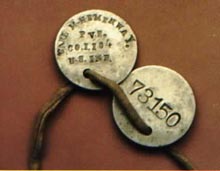
July 18,1918 -- "Quite badly shelled. Only two
gunners first platoon. Advance through open about 7 a.m. Take village
with little resistance. Advance on side hill, then take positions on
road back of hill, near Belleau. Germans come through wheat field after
bombardment. They don't return."
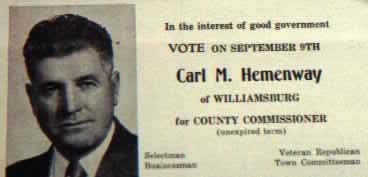
-- from the battlefield Diary of Carl Hemenway
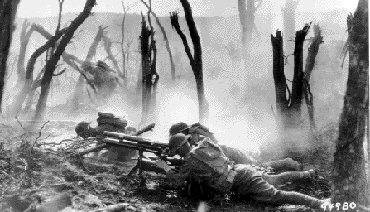
"THE BIG SHOW" - THE MEUSE-ARGONNE OFFENSIVE
The Meuse-Argonne Offensive was the biggest operation and
greatest victory of the American Expeditionary Force in the war. It was
a complex operation requiring the majority of ground forces to fight
through rough, hilly terrain that the German Army had spent four years
fortifying. The objective was to capture and control German railways in
France and thus force their withdrawal from occupied territories. Most
of the troops involved in this campaign had to be transferred from the
St. Mihiel Salient, assaulted less than two weeks before. The
reshifting of these forces in such a short period of time was one of
the great accomplishments of the war. The logistics were planned and
directed by Col. George C. Marshall, establishing his reputation and
preparing him to lead, in the not too distant future, American forces
to victory in the Second World War. The Meuse-Argonne Offensive
successfully forced the German retreat and leaders signed the Armistice
November 11, 1918, much earlier than anyone had expected.
The AEF initially mounted a series of attacks resulting in
high casualties but with small gains in ground. On October 8, 1918, Sergeant York of the 82nd Division wiped out a
nest of 35 machine gunners and captured 132 German soldiers. His
exploits earned him the Congressional Medal of Honor and a film was
made about him starring Gary Cooper. The following excerpts are taken
from Sergeant York, His Own Life and War Diary by Alvin C. York
"After the first few bursts a whole heap of other machine guns
joined in. There must have been over twenty of them and they kept up a
continuous fire. Never letting up. Thousands of bullets kicked up the
dust all around us. The undergrowth was cut down like as though they
used a scythe. The air was just plumb full of death….I was caught out
in the open, a little bit to the left and in front of the group of
prisoners and about twenty-five yards away from the machine guns which
were in gun pits and trenches upon the hillside above me. I was now in
charge….
"Well, I was giving them the Best I had….Every time I seed a
German I jes teched him off. At first I was shooting from a prone
position; that is lying down; jes like we often shoot at the targets in
the shooting matches in the mountains of Tennessee; and it was jes
about the same distance. But the targets here were bigger. I jes
couldn't miss a German's head or body at that distance. And I didn't."
"The German Major could speak English as well as I could.
Before the war he used to work in Chicago. When the prisoners in the
first trench surrendered I yelled out to my men to let's get them out.
And one of my men said it was impossible to get so many prisoners back
to the American lines. And I told him to shut up and to let's get them
out….I ordered the prisoners to pick up and carry our wounded. I wasn't
agoin' to leave any good American boys lying out there to die. So I
made the Germans carry them. And they did. And I takened the major and
placed him at the head of the column and I got behind him and used him
as a screen. I poked the Colt in his back and told him to hike…
"And so I done marched them straight at that old German
front-line trench. And some more machine guns swung around to fire. I
told the major to blow his whistle or I would take his head and theirs
too. So he blowed his whistle and they all done surrendered. All except
one. I made the major order him to surrender twice. But he wouldn't.
And I had to tech him off. I hated to do it. I've been doing a
tolerable lot of thinking about it since. He was probably a brave
soldier boy. But I couldn't afford to take any chance, and so I had to
let him have it. There was considerably over a hundred prisoners now.
It was a problem to get them back safely to our own lines. There was so
many of them there was danger of our won artillery mistaking us for a
German counter-attack and opening up on us. I sure was relieved when we
run into the relief squads that had been sent forward through the brush
to help us. "
On the way back we were constantly under heavy shell fire and
I had to double-time them to get them through safely. There was nothing
to be gained by having any more of them wounded or killed. They done
surrendered to me and it was up to me to look after them. And so I done
done it. I had orders to report to Brigadier General Lindsay, our
brigadier commander, and he said to me, "Well. York, I hear you have
captured the whole damned German army." And I told him I only had 132."
-- Alvin C. York
A see-saw battle ensued so Pershing ordered a reorganization.
The reorganized army began its final push in November.
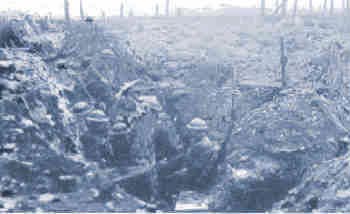
November 6, 1918 -- "Dirty
Germans send H.E.s ( High Explosives ) with gas in them. Fearfully
gassed. Throat, lungs, nose, mouth…"
- From the battlefield Diary of Carl Hemenway
ARMISTICE
On that final morning it seemed as if all hell had broken
loose along the entire front. In the back areas the artillery had
slammed everything it had over the heads of the crouching infantrymen.
The fire was unremitting as the hail of steel went sailing toward the
German lines. As 11 o'clock neared every gun was firing as fast as it
could be loaded. To the bark of the smaller field pieces was the
heavier crash of the 155's and still further back the roar of the great
14-inch naval railroad guns as these poked their big snouts skyward and
blasted out a final defiance.
Promptly at 11 o'clock the cannonade ceased and instead of the
horrible din - the explosion of deadly missiles - there was an uncanny
quiet. For the first time in weeks it was possible to stand upright
without fear of sudden death. Again men could walk like men. No longer
was it necessary to burrow in the ground like animals, to crawl and
slide from muddy shell hole to still another crater exactly like its
previous counterpart.
On the front lines there was neither celebration nor
jubilation. It was too big - too sudden. The climax had been reached.
Numbed human senses failed to respond. Officers peered out across No
Man's Land through eyes red rimmed from fatigue and loss of sleep. When
they spoke it was in tones hoarse and husky from the effects of gas.
The men, with the exception of sentries posted to keep the lines
intact, too exhausted to do more, dropped where they were and,
unmindful of wet, cold and mud, slept.
- from The Regiment: A History of the 104th Infantry AEF 1917
- 1919
CHOCTAW CODE TALKERS
When the Germans were making their final push in the Argonne,
for a while things did not look good for the Allies. It was discovered
that the Germans had not only broken the American radio codes but also
tapped the telephone lines. To make matters worse, they were able to
consistently capture 25% of the messengers who ran between companies on
the battlefield. Within the AEF, during the Meuse-Argonne offensive,
while virtually surrounded by Germans, Captain Lawrence was walking
through the field in which his company was positioned and happened to
overhear a strange language between two of his soldiers. The language
was the native tongue of the Choctaw people and the soldiers were
Corporal Solomon Lewis and Private First Class Mitchell Bobb.
Inspiration struck the Captain and he proceeded to organize eight
Choctaw men to transmit messages between units on the battlefield in
the Choctaw language. Their secret weapon confounded the Germans and
turned the tide of battle. Within 72 hours of implementing the
"scrambled" voice messages, the Germans were in full retreat of the
attacking Allied forces. The Choctaw Code Talkers not only saved their
battalion, but also invented secure communications in the closing days
of the war.
Later, during World War II, the most ambitious effort to
employ native languages as secret codes was championed by Philip
Johnston. Johnston was a World War I veteran who had come by covered
wagon to settle on Navajo land in northern Arizona with his missionary
family. By age 9, he was one of the few whites who were proficient
enough in the Navajo language that he served as interpreter between
Navajo leaders and President Theodore Roosevelt. Johnston had heard of
the Choctaw Code Talkers during World War I and set out, successfully,
to convince the military leadership during World War II that the Navajo
language could be similarly used. The rest is history.
"Your achievement, which is scarcely to be equaled in
American history, must remain a source of proud satisfaction to the
troops who participated in the last campaign of the war. The American
people will remember it as the realization of the hitherto potential
strength of the American contribution toward the cause to which they
had sworn allegiance. There can be no greater reward for a soldier or
for a soldier's memory."
By Command of Major General Hale:
Duncan K. Major, Jr.
Chief of Staff
Page: 2 of 2
Previous Pages 1
- 2
|