|
|||||||||||||||||||||||||
|
|||||||||||||||||||||||||
|
Page: 2 of 2
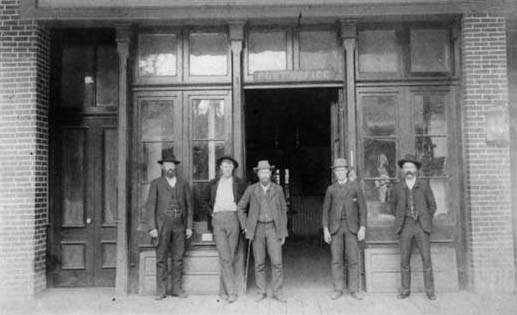
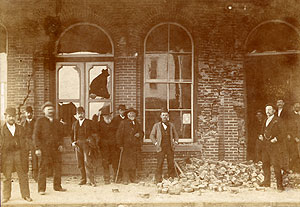
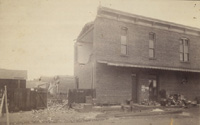
George W. Hemenway, third from left with cane,
was the Postmaster of Winters when this photo was taken in 1890. Above
the entrance are the words 'Post Office'.
G.A.R. Meeting HEADQUARTERS, COL. A.W. PRESTON POST, NO. 114, DEP'T CAL., G.A.R., Winters, Cal., January 24, 1891. At a regular meeting of this Post, held in Seaman's Hall, January 24, 1891, the following officers, being duly elected for the ensuing year, were properly installed by Senior Past Post Commander and Special Aid de Camp, J.P. Trumbull: Post Commander, G.W. Hemenway, Senior Vice, Joshua Steward, Junior Vice, J.P. Trumbull, Quartermaster, Samuel Cooper, Surgeon, P.J. Aiken, M.D., Chaplain, James Wilson, Officer of the Day, Joseph Connor, Officer of the Guard, J.W. Ball, Sergeant Major, A.N. Babcock, Quartermaster Sergeant, T.E. Boyd Representatives to Department Encampment, J.P. Trumbull, Joseph Connor, A.N. Babcock, G.W. Hemenway and P.J. Aiken, M.D. Alternate, James Wilson. Comrade Samuel Cooper was
admitted a member by transfer card. from the Winters Express, 1891
An Old Soldier and Well Known Citizen Passes to
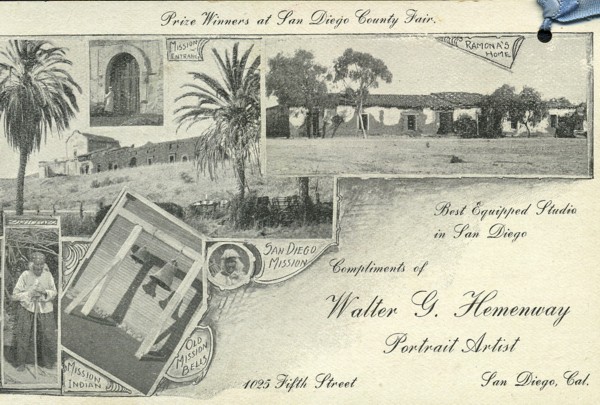
the Great Beyond Rather suddenly, though not entirely unexpectedly, the people of Winters were called upon Monday last to attend the last sad rites to the memory of a fellow townsman, G.W. Hemenway. He had long been a sufferer from disease resultant from exposure in the army, but for many years was able to attend to his business until last spring, when his old trouble returned with unusual rigor. On account of his age he had not the vitality to withstand it, and succumbed to the disease at 8:25 o'clock Sunday morning, December 9, at the home of his brother, Dwight Hemenway, where he had been receiving the best of care and undivided attention. A simple and impressive funeral service was held at the house of Dwight Hemenway Monday morning, Rev. H.C. Culton officiating, and the remains were interred in the Masonic cemetery. George Whitfield Hemenway was born at Wayne, DuPage county, Illinois June 17, 1842. Deceased was third of a family of ten children, six of whom are still living. Mr. Hemenway passed his boyhood days on his father's farm at Wayne. At the age of nineteen, September 23, 1861, he enlisted for three years as private in Co. K 36th regiment of Illinois volunteer infantry. He served through the Missouri campaign, was at the battle of Stone River, Wilson's Creek and Pea Ridge. His next battle was at Perryville, and it was during the march from Perryville to Murfreesboro that the disease developed which resulted in his death. It was while in the campaign around Chattanooga and Murfreesboro that he was discharged, October, 20, 1863, as physically unfit for military duty. He returned home and having to some extent recovered, he and his father went to Atchinson, Ill., as broom makers. When Mr. Hemenway again returned home he was elected tax collector of Wayne township. He then completed a course in the business department of Wheaton College and secured employment in the wholesale stationery establishment of Ezra Cook in Chicago. He was married November 17, 1869, to Anna Filer, whom he met while they were students at Wheaton College. After the Chicago fire in which Ezra Cook's establishment was burned, he found employment in printing the Christian Cynosure, a paper edited by President Blanchard of Wheaton College. In 1877 Mr. Hemenway and wife moved to Kansas, bringing three children, Walter, Luella and Fred, born to them in Chicago. He remained in Kansas, near Madison, conducting a farm ten years. Here Harvey and Jessie were born. The family moved to Winters in the fall of 1887, where deceased served for six years as postmaster, to the entire satisfaction of the community. The deceased was prominent in G.A.R. circles, a well-known and respected citizen of Winters and an enthusiastic supporter of all patriotic movements. Besides the five children, who are all living, he leaves and invalid wife to mourn his loss. The heartfelt sympathy of the whole community reaches out to comfort the bereaved ones in their deepest sorrow. -from the Winters Express December 1900The President appoints George Postmaster Click to enlarge Walter G. Hemenway owned and
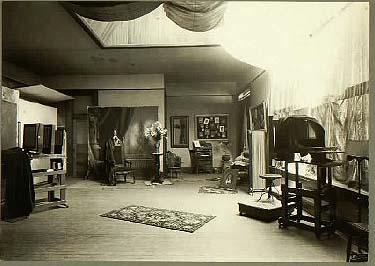
operated several studios in
Northern and Southern
Walter George (Wally) Hemenway and his studio in San Diego
Early Hemenway Photographs
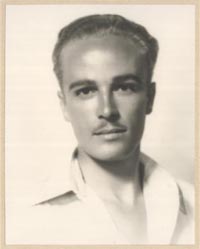
Walter, known as the "Photographer to the Stars", shot this portrait during Harvey's visit to Los Angeles to attend the Olympics in 1932.
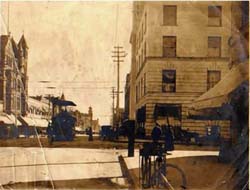
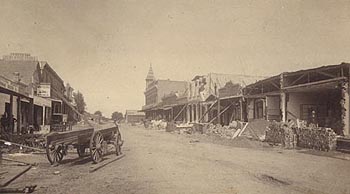
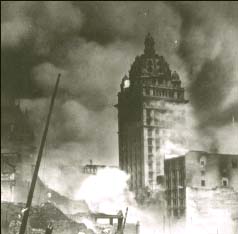
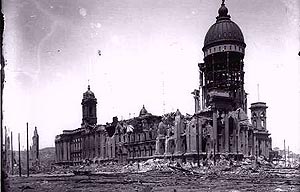
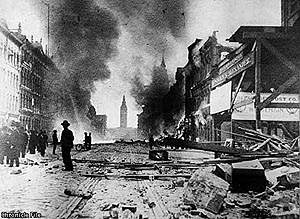
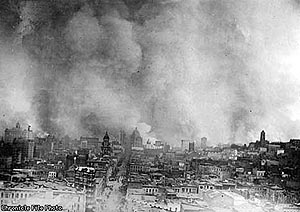
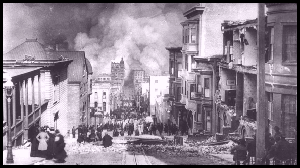
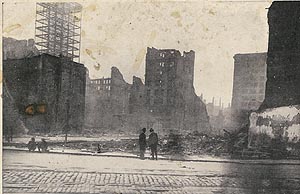
"It was bedlam, pandemonium, and hell rolled
into one."
The evacuation of San Francisco 1906
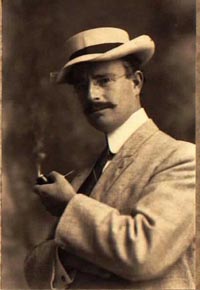
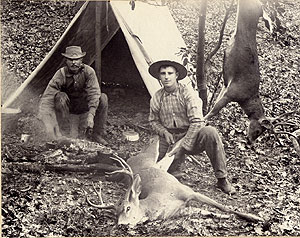
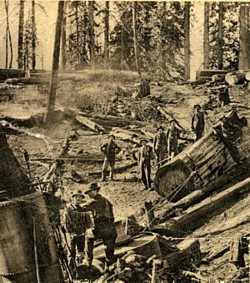
Harvey Edwin (Scoot), youngest son of George and
Anna. He was an avid hunter and logger in Mendocino County. Scoot is
pictured at the far right. Scoot led a hard life of drinking and
smoking and eventually died of tuberculosis.
|
|||||||||||||||||||||||||
 |
|||||||||||||||||||||||||
|
|
|||||||||||||||||||||||||
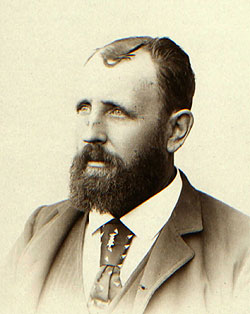 George Whitfield Hemenway was one of the early
postmasters of Winters. He was also a printer and proprietor. He died
at a relatively
young age while his son Fred was attending school at the University of
California in Berkeley. It is said that his service in the war damaged
his health, precipitating his untimely death.
George Whitfield Hemenway was one of the early
postmasters of Winters. He was also a printer and proprietor. He died
at a relatively
young age while his son Fred was attending school at the University of
California in Berkeley. It is said that his service in the war damaged
his health, precipitating his untimely death.